Good Bones

Updated: Jul 21

Good bones is an impromptu series of drawings, delineating animal skulls found in the wilderness. Initially the drawings were created simply for practice, something to draw between other projects or on breaks. Out of the habit of architectural drawing conventions, I began to draw the collection orthographically. I drew conventional elevations at first, but soon began experimenting with rotational and oblique elevations. Regulating lines organized the systematic view on each page. Upon one occasion, when reviewing a number of drawings at once, I noted that the regulating lines in one of the rotational drawings appeared to function like frames for an animation. The realization was immediate as the drawings already contained an explicit sequence. I wondered, If animated, could a sequence of 5 or so observational drawings create the illusion of movement? I soon found out that it could, and not only that, but in the process of animation, new insights into spatial perception became apparent.
Animations in this series have become a useful process to gain insight into the perception of space within a drawing. Procedurally, these animations differ from traditional hand drawn techniques as my work does not use a method of overlaying images. Instead, each frame is a drawing strictly from observation of the skull held in the opposite hand. Due to this process, each "frame" is a finished work in its own right, with its own implication of spatial positioning and independent visual hierarchies. Although each observational work is usually completed successively, a consistent quality is achieved, but they are still subject to independent observational errors. That independence became crucial once the drawings were sequenced.
In animation, the spatial framework that emerges is fundamentally different from what a static image produces. The perception of movement causes the fidelity of transitions to be privileged. If the shifts between frames are smooth enough, the eye treats discrepancies between frames as noise and discards them. The animation therefore establishes its own perceptual hierarchy—one in which continuity becomes the dominant spatial signal, overruling the representational details that would matter in a static drawing. This creates a codependent condition: the transitions generate the spatial context through which they are understood, and that context in turn determines which information is registered or ignored for context creation. In the static drawings, where no such transitional fidelity exists, spatial reading depends instead on the details of representation itself.
This iterative series makes it apparent that the process, means, and sequence of viewing drawings, enliven separate sets of perceived hierarchical and spatial elements within a set of images. Discovering methods to separate the differing visual logic in a single image opens up a number of questions and possibilities that I am continuing to investigate. However a familiar question re-emerges, it is a recapitulation of the question that has continued to drive my working drawings series. Can the overlapping conditional hierarchies within an image be identified and isolated as design variables? If so, can those variables be used to create spatial linkages between corporeal and pictorial space? Although these questions have not yet been answered, I would love to envision this as an initial step on the process to create works that move beyond a spatial trick of Trompe-l'œil, but instead build interesting and palpable correspondences between what is seen, and what is perceived in a work.
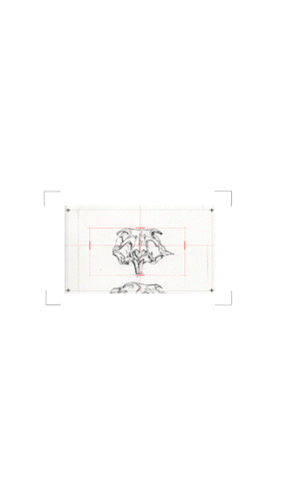

STUDY 1: Full rotation through the human skull from observational drawings. 180° of rotation was drawn in 10 frames. These 10 frames were mirrored to create 360° of apparent rotation.


![Working Drawing 1[.1]](https://static.wixstatic.com/media/353066_771d70d7bb2a458d92e3ca4e016137cc~mv2.jpg/v1/fill/w_980,h_578,al_c,q_85,usm_0.66_1.00_0.01,enc_avif,quality_auto/353066_771d70d7bb2a458d92e3ca4e016137cc~mv2.jpg)

Comments